


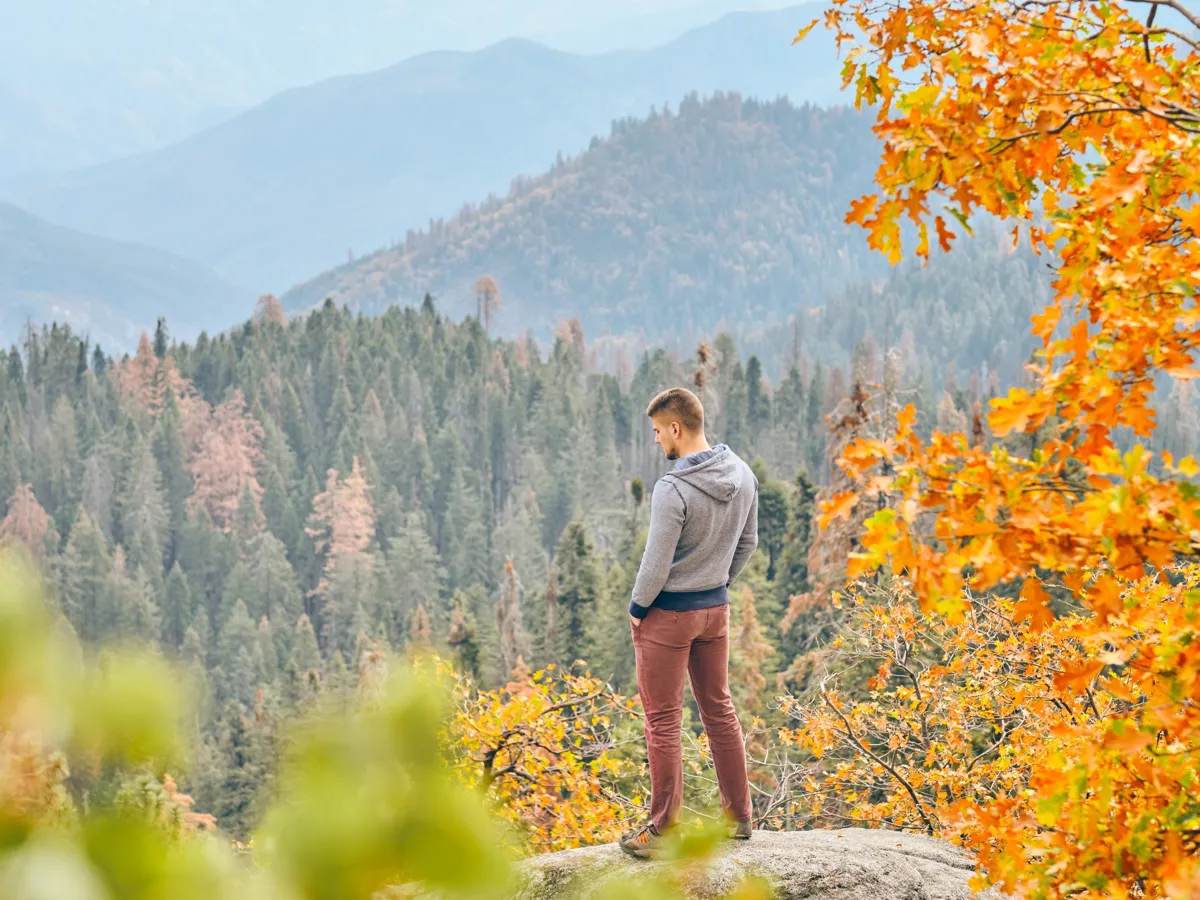
Sequoia National Park spends the summer doing crowd control. Then Labor Day passes, the school run starts up in the Central Valley, and the park quietly becomes the place everyone hoped it would be: cool mornings, warm afternoons, parking at the trailheads, and the largest trees on Earth with almost nobody standing under them.
Autumn is the most underrated season here, and it comes with one surprise that catches nearly every first-time visitor. The giant sequoias do not change colour. They are evergreen conifers; they look in October exactly as they looked in July. The gold you came for is growing underneath them.
Why autumn is the right call
The case is mostly about crowds and temperature, in that order.
Sequoia takes somewhere north of a million visitors a year, and they are not spread evenly – the summer months carry the bulk of them, and the Giant Forest parking areas are the pinch point. You can see the shape of it in the park’s annual visitation figures. By late September the day-use pressure has dropped sharply, and by late October the Giant Forest on a weekday can feel close to empty.
The temperature argument is just as strong. The foothills around the Ash Mountain entrance are brutal in midsummer and pleasant in October. Up at the Giant Forest, around 6,400 feet, autumn days tend to sit in the comfortable range for walking all day, and the nights get properly cold. The light is better too: the low sun angle reaches further into the groves, which is the difference between a photograph of a big tree and a photograph of a big tree you can actually see.
What actually turns gold
Worth repeating, because it shapes where you point the car: the sequoias stay green. The autumn colour in this park comes from the broadleaf trees living among and below them.
The headline act is the California black oak, which grows right through the Giant Forest and turns a deep yellow-gold, often directly beneath the sequoias – that contrast of gold leaves against cinnamon-red bark is the signature autumn image of this park. Pacific dogwood in the same groves goes pink and red, usually a little earlier. Lower down, bigleaf maple and the cottonwoods and willows along the rivers turn yellow, and they hold their colour later than anything up high.
Because the colour lives at every elevation but peaks at different times, there is no single “peak week” for the park as a whole. It rolls downhill for about six weeks.
Where to point the car
1. The Giant Forest and the General Sherman Tree
The General Sherman Tree is the largest living thing on the planet by trunk volume, and the Giant Forest around it holds a large share of the biggest sequoias anywhere.
In autumn this is also where the best colour is, because the black oaks grow right in among the big trees. Walk the Congress Trail, a paved loop of roughly two miles from the Sherman parking area, and you get the monarchs, the oaks and almost none of the summer queue. The other headline stops in the park are all within a short drive of here.
2. Moro Rock, once the haze has gone
A granite dome with a staircase of roughly 350 steps cut and built into it, ending on a summit with a long view east to the Great Western Divide.
This is a specifically autumnal recommendation. Summer views from Moro Rock are frequently washed out by Central Valley haze and, increasingly, by wildfire smoke. After the first proper storm of the season the air clears and the view is genuinely startling. Go early, dress for wind, and note that the road out to it closes to vehicles once winter sets in.
3. Crescent Meadow and Tunnel Log
John Muir called Crescent Meadow the gem of the Sierra, and in autumn the meadow grass goes bronze and the surrounding dogwood turns over.
The same dead-end road takes you past Tunnel Log, a fallen sequoia with a gap cut through it that small cars can still drive under. It is a short, flat, extremely rewarding walk around the meadow, which makes it the best option here for anyone not looking for a climb. The road is seasonal – it is one of the first things to shut when snow arrives.
4. Mineral King, if you have the time
A high glacial valley at around 7,500 feet, reached by a narrow, winding road of roughly 25 miles that takes most drivers about ninety minutes each way from Three Rivers.
It is the best autumn hiking in the park and the least visited corner of it, precisely because that road filters out casual traffic. It is also the first area to close – the road typically shuts for the winter around late October and does not reopen until late spring, so this is a stop that autumn gives you and then takes away. Check the road status the day before you commit to it.
5. Grant Grove and the edge of Kings Canyon
Sequoia shares a boundary and an operation with Kings Canyon, and Grant Grove sits just over the line with the General Grant Tree in it – the Nation’s Christmas Tree, and a living memorial to American war dead.
Grant Grove stays reachable all year. The scenic drive deeper into Kings Canyon toward Cedar Grove does not: that stretch of Highway 180 usually closes from around mid-November until spring. If you want the canyon itself, autumn is close to your last chance in the calendar.
The park is a staircase, not a place
The single most useful thing to understand before driving in is the elevation. The Ash Mountain entrance sits under 2,000 feet; the Giant Forest is around 6,400; the park’s back corner holds Mount Whitney at 14,494 feet, the highest point in the lower 48. You can gain the better part of 5,000 feet in well under an hour of driving.
Practically, that means the temperature at the entrance station tells you nothing about the temperature where you are going – a warm afternoon in the foothills is a cold one in the groves, and it can be snowing up top while the oaks below are still in full leaf. Pack layers you would not think you need.
It also means the drive is the real constraint. The Generals Highway climbs hard and turns constantly, and the Park Service advises vehicles over about 22 feet avoid the stretch between Potwisha and the Giant Forest. Large RVs should take the Highway 180 approach through Grant Grove instead.
What closes, and when
Autumn is the season the park starts folding itself up, and the order is fairly predictable even though the dates move year to year.
- Mineral King Road usually closes around late October.
- Moro Rock / Crescent Meadow Road closes to vehicles once snow arrives.
- Highway 180 into Kings Canyon beyond Grant Grove typically shuts around mid-November.
- Crystal Cave runs a seasonal schedule and has been closed entirely in some recent years – never build a day around it without checking first.
- Chain controls can appear on the Generals Highway from October onward. California requires you to carry chains in a control area even if your vehicle has four-wheel drive.
None of these dates are promises. The park’s current conditions page is the only source worth trusting in a given week.
Fire is part of the picture now
You will see burnt ground, and it is worth knowing why before you do.
The Castle Fire in 2020 and the KNP Complex in 2021 both burned through groves of giant sequoias. The Park Service’s estimates put the losses at a meaningful share of all the large sequoias in existence – these trees are adapted to fire and need it to reproduce, but not to fire of that intensity. Stands of rust-coloured dead conifers across the ridges are the visible result, along with drought and bark beetle damage.
This is not a reason to stay away. Recovery is genuinely interesting to walk through, and the Park Service is candid about it on interpretive signs. But some trails and areas remain closed or altered, so check before you plan a specific route.
One more autumn habit: the bears
Black bears spend the autumn in hyperphagia, eating more or less constantly to put on weight before winter, which makes them bolder and more interested in your car than at any other time of year. Food storage lockers at trailheads and campgrounds are not advisory. Anything scented goes in the locker, including toiletries and an empty cooler, and nothing edible stays visible in a parked vehicle.
Do giant sequoias change colour in the fall?
No. Giant sequoias are evergreen conifers and look the same in October as in July. The autumn colour in the park comes from California black oak, Pacific dogwood, bigleaf maple, and the cottonwoods and willows along the rivers – much of it growing directly beneath the big trees.
When is peak fall colour in Sequoia National Park?
There is no single peak, because the park spans more than 10,000 feet of elevation and the colour moves downhill. As a rough guide the mid elevations around the Giant Forest turn through mid-to-late October, while the foothills and riverside trees hold on into November. Higher country turns earlier.
Is Sequoia National Park less crowded in the fall?
Substantially. Visitation is concentrated in the summer months, and the drop after Labor Day is steep – a weekday in late October at the Giant Forest is a completely different experience from a Saturday in July. The trade-off is reduced services and progressively more closures.
Will it snow, and do I need chains?
Snow is possible at the higher elevations from October onward. California chain controls can be in force on the Generals Highway, and when they are, you are required to carry chains even with four-wheel drive. Check road conditions the morning you travel rather than the week before.
Can you still see the wildfire damage?
Yes, in a number of places – burnt stands and rust-coloured dead conifers are visible from several viewpoints and roads. Some trails and areas remain closed or rerouted as a result, so confirm your specific route is open before setting out.
The short version
Come after Labor Day and before the middle of November. Base yourself near Three Rivers or in the Giant Forest area, walk the Congress Trail among the black oaks, climb Moro Rock on the clearest morning you get, and drive Mineral King early in the window before the road shuts. Carry layers for a 5,000-foot climb, carry chains once October turns, and put everything that smells of anything in the bear locker.
The trees are the same size all year. Autumn is just when you get to stand under them by yourself.


